Chapter 1: Renaissance, Scientific Revolution & Enlightenment Thought
1. The Renaissance & Humanism
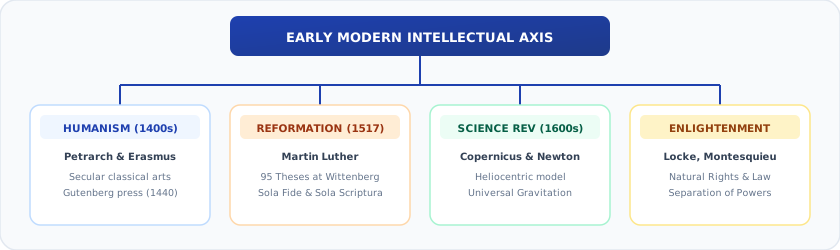
Originating in 14th-century northern Italian city-states (Florence, Venice), the Renaissance (Rinascimento) represented a rebirth of classical Greco-Roman learning, prioritizing Secular Humanism:
- Literary Pioneers: Petrarch (Father of Humanism), Boccaccio (Decameron), and Niccolò Machiavelli (The Prince - autonomous political realism).
- Visual Arts: Linear perspective and anatomical precision by Leonardo da Vinci, Michelangelo, and Raphael.
- The Printing Press (c. 1440): Johannes Gutenberg's movable metal type mechanized book production, shattering clerical information monopolies.
2. The Protestant Reformation & Scientific Revolution
- Protestant Reformation (1517): Martin Luther nailed the 95 Theses to the Wittenberg church door, attacking papal indulgences and advocating Sola Scriptura (Scripture alone) and Sola Fide (Faith alone).
- The Scientific Revolution:
- Nicolaus Copernicus (De revolutionibus 1543): Heliocentric cosmology replacing Ptolemaic geocentrism.
- Galileo Galilei: Telescopic confirmation of heliocentrism; laws of falling bodies.
- Isaac Newton (Philosophiae Naturalis Principia Mathematica 1687): Universal Gravitation and three laws of motion.
3. Enlightenment Political Philosophers
| Thinker | Core Work | Primary Political Contribution |
|---|---|---|
| John Locke | Two Treatises of Government (1689) | Natural Rights (Life, Liberty, Property); Government by consent; Right to revolt |
| Montesquieu | The Spirit of the Laws (1748) | Separation of Powers (Executive, Legislative, Judicial) to prevent tyranny |
| Voltaire | Treatise on Tolerance (1763) | Freedom of speech, civil liberties, critique of religious fanaticism |
| Jean-Jacques Rousseau | The Social Contract (1762) | General Will (Volonté Générale); Direct popular sovereignty |
| Adam Smith | The Wealth of Nations (1776) | Laissez-faire capitalism; Division of labor; The "Invisible Hand" |
Check Your Mastery
⚡ Concept Quick-CheckTest Your Conceptual Intuition
Which Enlightenment philosopher formulated the doctrine of the Separation of Powers into three distinct branches of government to safeguard civil liberties?