Chapter 6: Cold War Bipolarity, Decolonization & Non-Aligned Movement
1. Cold War Ideological Bipolarity (1947–1991)
Following the Yalta and Potsdam conferences, the post-war world polarized between two nuclear-armed superpowers:
- Western Bloc (USA): Liberal democracy, free-market capitalism, Truman Doctrine (1947), Marshall Plan, and the NATO alliance (1949).
- Eastern Bloc (USSR): State socialism, planned economy, Cominform, and the Warsaw Pact (1955).
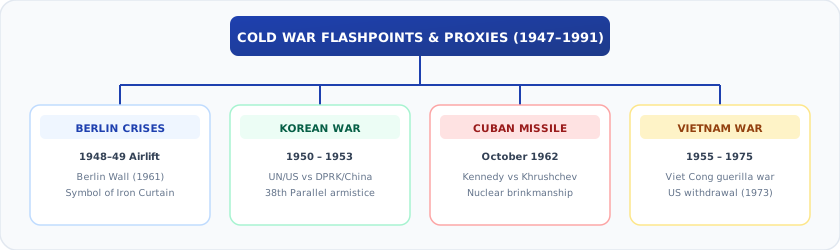
2. Decolonization & The Non-Aligned Movement (NAM)
Newly independent states across Asia and Africa rejected alignment with either superpower bloc:
- Bandung Conference (1955): 29 Afro-Asian nations established the Ten Principles of Bandung (Panchsheel).
- First NAM Summit at Belgrade (1961): Led by Jawaharlal Nehru (India), Josip Broz Tito (Yugoslavia), Gamal Abdel Nasser (Egypt), Kwame Nkrumah (Ghana), and Sukarno (Indonesia).
3. Dissolution of the Soviet Union (1991)
Under General Secretary Mikhail Gorbachev, twin reform policies:
- Glasnost (Openness): Freedom of speech, press, and political transparency.
- Perestroika (Restructuring): Decentralization of economic planning.
- The End: Fall of the Berlin Wall (November 1989), formal dissolution of the USSR on December 25, 1991, yielding 15 sovereign republics.
Check Your Mastery
⚡ Concept Quick-CheckTest Your Conceptual Intuition
The historic 1955 Asian-African Conference that laid the foundational principles for the Non-Aligned Movement (NAM) was held in which city?